
Resources
17 September 2026 · 4 min read
What is e-commerce fulfilment, in practice?
The word is everywhere, and often vague. E-commerce fulfilment is the sequence of operations between an order placed on your store and a parcel delivered to your customer: receiving, storage, picking, packing, shipping, returns. Here is how it works and what an outside provider does on your behalf.
E-commerce fulfilment: the definition
E-commerce fulfilment covers every operation that turns an online order into a delivered parcel: receiving and checking the goods, storage, picking, packing, handover to the carrier, then processing the return if the customer sends the item back. It is the operational side of selling online, invisible to the customer as long as it works, and highly visible the moment it fails.
A fulfilment provider, or 3PL (third-party logistics provider), takes charge of this chain on the online retailer’s behalf. You carry on selling and managing your catalogue; the physical stock, the packing stations and the carrier contracts sit with the provider.
Fulfilment, fulfillment, e-fulfilment, e-commerce logistics: four words for the same job. In Belgium, the usual spelling is fulfilment; in France, fulfillment. The provider that handles it is called a 3PL or an e-commerce logistics provider. At Brain e-Log, this covers receiving, storage, picking, shipping and returns, from a 22,500 m² warehouse in Houdeng-Goegnies, in the municipality of La Louvière.
The steps, in order
1. Receiving. Goods arrive on pallets or in cartons. Every SKU is counted and checked on arrival, and discrepancies are reported the same day.
2. Storage. Stock is split between picking bins, for fast-moving SKUs, and pallet racking for reserve stock. The WMS (warehouse management system) knows where every unit is and how much is available, in real time.
3. Order intake. From your connected store, a marketplace or an ERP, the order flows automatically into the WMS. No re-keying.
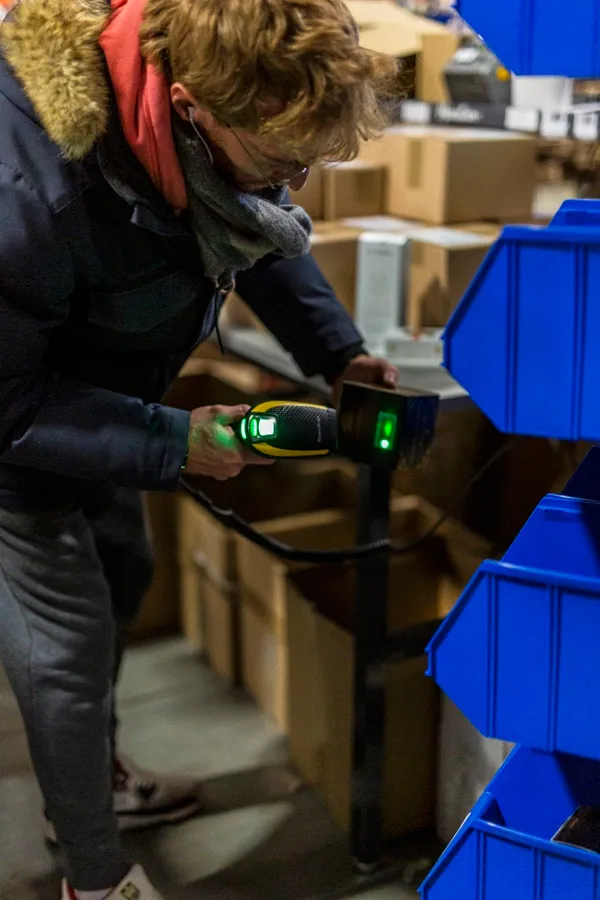
4. Picking. An operator picks the items in the order. Scanning each item at its location and again at the packing station greatly reduces the risk of error.
5. Packing. Box or mailer, void fill, an optional insert, according to the specifications you have agreed with the provider.
6. Shipping. The label is printed and the parcel is handed to the right carrier for the destination and the service requested. The tracking number is sent back to your store.
7. Returns, if needed. The returned parcel is received, inspected against your criteria, and put back into stock or set aside. Its status is sent back to your store to trigger the refund.
What a fulfilment provider changes in practice
At Brain e-Log, 130,000 parcels a month go through the order picking stations of our warehouse in Houdeng-Goegnies, in Hainaut. That volume delivers three things an online retailer on its own struggles to get:
- Carrier rates negotiated on volume, through 14 carriers and coverage of 150 countries, rather than a single contract at list price.
- Systematic quality control (double scan) rather than occasional in-house checks, squeezed in when time allows.
- Capacity that absorbs peaks (Q4, sales, product launches) without the online retailer hiring temporary staff.
Import, customs, B2B and marketplaces: flows that come together
Fulfilment doesn’t stop at the standard B2C order. A brand importing from Asia needs upstream customs clearance before the stock enters the warehouse: see our import and customs page. A brand that also supplies distributors by the pallet, on top of its online orders, needs the same stock to serve both channels. A brand that sells on Amazon as well as on its own store needs the two flows not to duplicate the physical stock. These are variations on the same mechanism: receiving, storage, picking and shipping, applied to different channels from a single stock.
Why outsource in Belgium
Belgium is less than a day’s drive from most major cities in Western Europe, which makes it a sensible entry point for delivering to Belgium, France, the Netherlands, Luxembourg and Germany from a single stock. A warehouse in Hainaut, like Brain e-Log’s in Houdeng-Goegnies (22,500 m²), combines this central position with direct access to the main motorways. The remaining question is when the numbers start to work in your favour: see how many orders before outsourcing makes sense.
In short
Fulfilment is not an abstract concept: it is a chain of precise steps, each of them measurable (lead time, error rate, returns turnaround). A well-chosen 3PL doesn’t replace your customer relationship, it supports it: the parcel leaves on time, the return is processed quickly, and you see every step in the provider’s system rather than in a shared spreadsheet.
Frequently asked questions about fulfilment
01Are fulfilment and logistics the same thing?
No. Logistics covers all movement of goods, including inbound transport and B2B. Fulfilment refers specifically to the order-picking-shipping chain for online sales, from the click to buy to the delivered parcel.
02How many orders before you should outsource fulfilment?
There is no universal threshold. The most reliable signal is not a number of orders but how much of your week picking takes up: when it eats into business development, outsourcing starts to make sense.
03Does fulfilment also cover returns?
Yes, with a full-service provider. A return received, inspected and put back into stock is part of the same flow as shipping: this is reverse logistics.
04Can I keep part of the picking in-house?
Some brands keep kitting for specific campaigns or a premium range in-house and hand everyday volume to a 3PL. The split is defined at the start, in the specifications.
05Can a 3PL manage several stores and marketplaces from a single stock?
Yes, that is the main benefit: Shopify, WooCommerce, PrestaShop, Amazon or bol all feed into the same WMS and draw on the same stock, with no double entry.