
Resources
17 September 2026 · 3 min read
E-commerce returns management: a guide to keeping costs down
A return costs you twice: the transport, then the product tied up until it has been inspected and restocked. Here is how to structure e-commerce returns management so that it stays fast and weighs as little as possible on your margin.
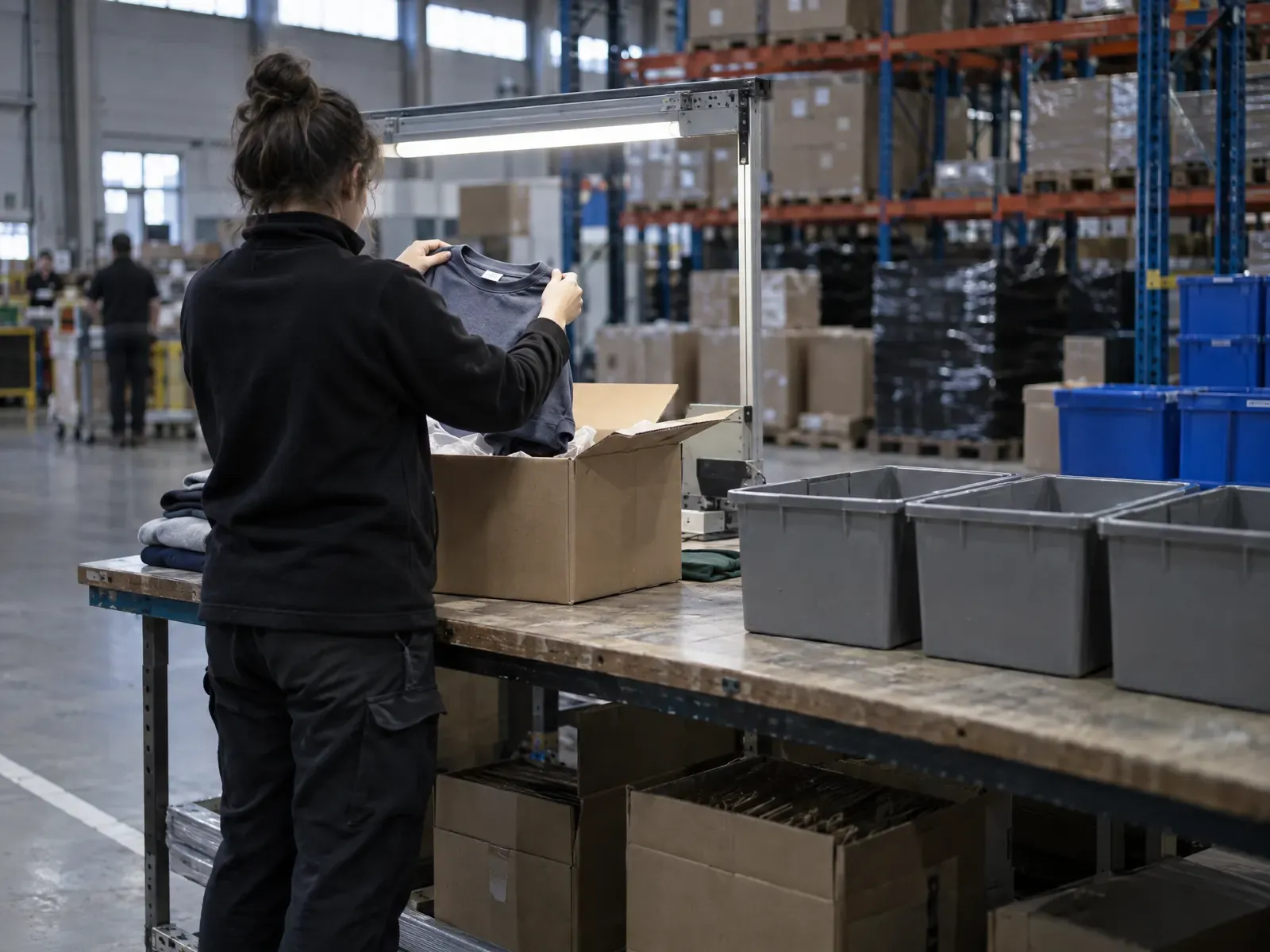
Understanding what is at stake in returns management
Returns rates vary widely by sector: often between 15% and 25% in fashion, compared with 2% to 5% in cosmetics. Either way, a poorly managed return ties up capital: the product only becomes saleable again once it has been inspected and restocked. The longer this takes, the higher the opportunity cost, especially for fast-moving references.
Returns don’t arrive at the same pace all year round either: Christmas returns come back in January, in a concentrated wave. This capacity should be planned at the same time as the year-end order peak.
Structuring a simple returns process
An effective returns process comes down to four steps, always in the same order:
1. Receiving. The returns parcel arrives at the warehouse. Scanning the label automatically identifies the original order, with no manual re-entry.
2. Inspection. Each item is checked against criteria written down in advance: condition, tags, seals, accessories, original packaging. These criteria are set by the online retailer, not improvised by the operator.
3. Restocking or setting aside. A compliant item goes back to its picking location and becomes saleable again. A non-compliant item is set aside and classified according to predefined rules: refurbishment, return to supplier, destruction, donation.
4. Triggering the refund. The return status feeds back into the online store, which triggers an automatic or manual refund depending on the rule chosen.
Receiving, inspecting, restocking: the detail that matters
The time between receiving a returns parcel and actually restocking it directly determines how long a product remains unsaleable. An inspection time of a few working days, rather than several weeks, limits the impact on revenue, especially for fast-moving references.
A regular report by reference, by country and by reason for return also helps you spot recurring problems: a mislabelled size, packaging that gets crushed in transit, or a marketplace generating twice as many returns as your own online store. These signals are corrected at source, not just at the returns-handling stage.
Cutting costs through reverse logistics
Return transport structurally costs more than the original shipment: the carrier collects a single parcel, sorts it once more, and delivers it to a single address. In Belgium, for example, a returns label costs €6.18, compared with €4.52 for the best tracked outbound service. The gap widens considerably for international shipments.
Three practical levers to keep this bill down:
- Reserve free labels for reasons that justify them (product defect, picking error), rather than offering them for every return without distinction.
- Consolidate multi-item returns into a single parcel rather than several separate shipments.
- Offer pick-up point delivery for outbound parcels: the customer already knows the drop-off point for any return, which makes collection simpler. See pick-up point or home delivery to choose which option to offer.
How Brain e-Log handles returns
At Brain e-Log, returns processing takes place in the same warehouse as shipping, with the same operators and the same system. Prepaid returns labels are available in 13 countries, from €6.18 for a parcel up to 1 kg in Belgium. The online retailer sets its own inspection criteria; the warehouse applies them and passes the status to the store to trigger the refund, without the retailer having to handle the money themselves.
The service also covers returns the customer never asked for: address not found, recipient not in, parcel refused. These carrier returns are identified as soon as the failed delivery event occurs, before the parcel physically arrives, giving customer service time to get back in touch with the recipient.
To place this cost within your overall logistics budget, the cost per parcel calculator includes your returns rate in the calculation.
In short
Returns management is not just about accepting a parcel sent back: it is a four-step process that determines how long a product stays unsaleable and how much return transport really costs. Online retailers who track these figures by reference and by reason fix recurring problems at source, rather than simply absorbing the cost.
Frequently asked questions about e-commerce returns
01Who decides whether a returned item can be resold?
The online retailer sets the criteria (condition, packaging, tags, accessories); the warehouse applies them. For borderline cases, the decision goes back to the retailer, with supporting photos if that option is enabled.
02Should you charge the customer for the return?
It is a commercial choice, not an obligation. Three common options: a free label for everyone, a paid label for everyone, or a free label depending on the reason for return (defect, picking error).
03Why does a return cost more than an outbound shipment?
The carrier collects the parcel from a pick-up point or the customer's home, sorts it once more, and delivers it to a single address (the warehouse). This individual collection structurally costs more than a consolidated outbound shipment.
04How can you reduce the returns rate without eliminating returns?
Three effective levers: accurate product pages (size, material, dimensions), photos that are true to life, and a clear size guide for fashion. Returns due to the wrong size remain the leading cause in that sector.
05Do returns from abroad follow the same process?
The principle is the same (receiving, inspection, restocking), but the cost of return transport varies widely depending on the country of origin, and returns from outside the EU require customs documents for re-import.